
Knox County Court Records After Arrest
A Knox County jail arrest and a Knox County court record are linked, but they are not the same record. The jail record is held by the sheriff and shows custody, booking, bond, and release facts. The court record starts when a complaint, information, indictment, citation, or related filing opens a case with the proper court. For many readers, the most important question is whether the booking charge became a filed charge, was changed by the prosecutor, was dismissed, or moved to another court.
Local offices named in the research include the Knox County and District Clerk, the County Attorney, the 50th Judicial District Attorney, the County Court, the Justice of the Peace, and municipal courts in Knox City and Munday. For custody and booking records, use the jail and sheriff channels described on the Knox County inmate records page. For booking photos, use the Knox County jail mugshots page.
Find Knox County Court Records After Arrest
No Knox County criminal case portal was found on the county site in the research, so the court-record path combines statewide search and local clerk contact. re:SearchTX is the statewide court search portal for participating Texas courts, but public access may vary by court, case type, document, age, confidentiality, and sealing. Registration or document fees can apply for some access.
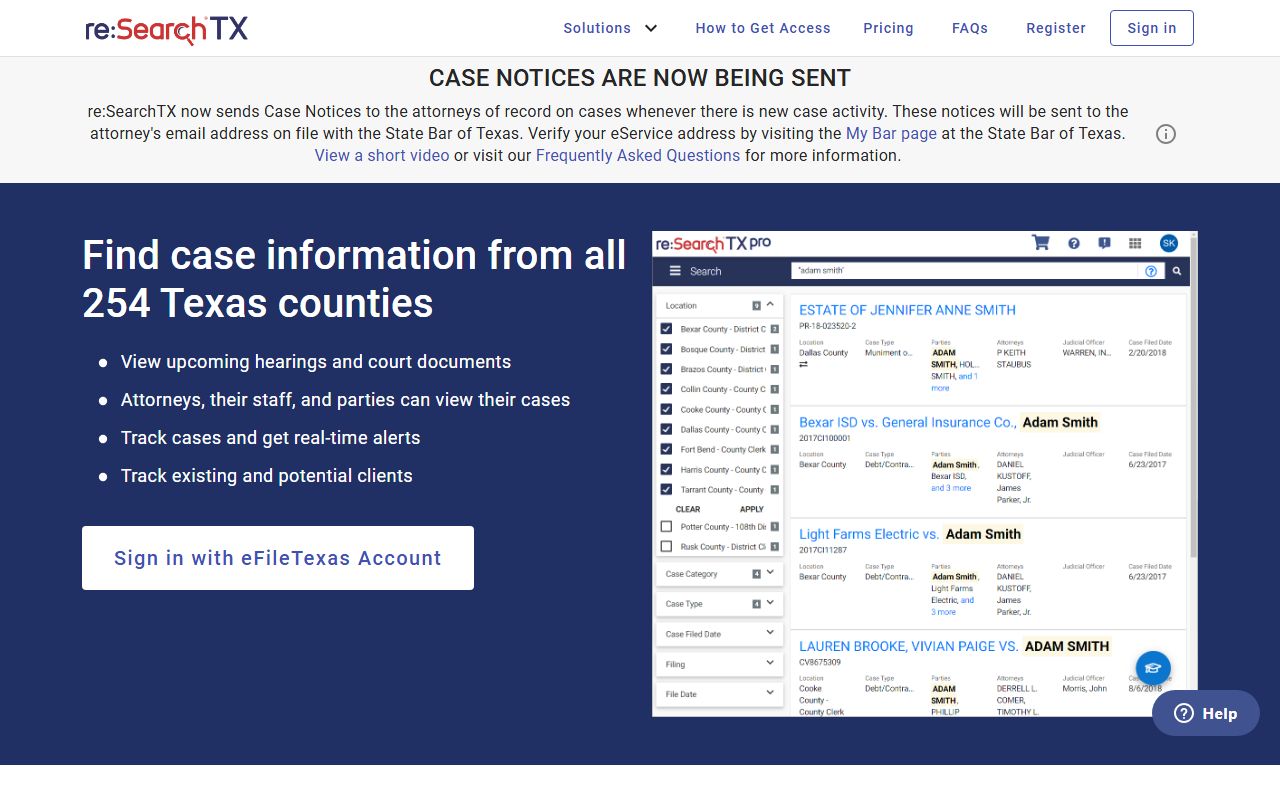
The re:SearchTX screenshot from the research set shows the statewide portal that may help locate court records after a Knox County jail arrest when the court participates.
If the portal does not show the case, the Knox County and District Clerk remains the practical contact for misdemeanor, felony, and district or county case records.
- Start with the jail if the person was just booked and ask for booking charges, bond, warrant numbers, and any case numbers.
- Search re:SearchTX by party name or case number if the court data is available there.
- Call the County and District Clerk at (940) 459-2441 for county and district case records.
- For first appearance, citations, or smaller matters, check Justice of the Peace or municipal court contacts.
- Compare jail booking charges with filed court charges because the prosecutor may amend, reject, enhance, or replace the original allegation.
Knox County Court Search Fields
The research captured general re:SearchTX fields, not a Knox-only criminal portal. Use the case number if it is known from jail paperwork, bond documents, a citation, a court notice, or clerk correspondence. Name searches can work, but they are easier to confuse when initials, middle names, suffixes, or spelling variations differ from the booking record.
| Field Label | Type | Required | Notes |
|---|---|---|---|
| Name or Party Search | Text | Usually optional until search | Search by defendant name where court data is available. |
| Case Number | Text | Optional | Best field when known from jail or court paperwork. |
| Court or Location | Dropdown or filter | Optional | Availability depends on portal interface and court participation. |
| Date Filed or Date Range | Date filter | Optional | Narrows results when the arrest date is known. |
| Case Type | Filter | Optional | Use criminal filters where available. |
Knox County Court and Prosecutor Contacts
Knox County court records after a jail arrest can route through several offices. The correct office depends on the charge level, issuing court, and case stage. Felony matters may involve district court and the 50th Judicial District structure. County-level misdemeanors can involve the county court and county attorney. Class C, traffic, ordinance, and municipal warrant matters may involve the Justice of the Peace or municipal courts.
County and District Clerk
Jeannie Clark
PO Box 196, Benjamin, TX 79505-0196
(940) 459-2441
Courthouse 1st floor; county and district record contact.
50th Judicial District Attorney
101 S Washington St.
Seymour, TX 76380-0508
(940) 889-2852
District-level prosecution contact listed on the Knox County page.
Charges Filed After Knox County Arrest
Booking charges are early custody entries. Formal court charges are filed through charging documents. A complaint is an initial sworn allegation. An information is a prosecutor-filed charging instrument often used in misdemeanor cases and some waived-indictment settings. An indictment is returned by a grand jury and is common in felony prosecution. A Knox County arrest can move through one or more of these document types before the court record is final.
| Document | Who Uses It | What It Does |
|---|---|---|
| Complaint | Officer, complainant, or prosecutor process | States the alleged offense and supports early court action. |
| Information | Prosecutor | Formally charges many misdemeanor cases and some waived-indictment matters. |
| Indictment | Grand jury | Returns a felony charging document after grand-jury review. |
Knox County Charge Status
Charge status can change after arrest. A jail booking record may list the arresting agency's charge, while the court record may later show a different charge, amended wording, added counts, a reduced level, dismissal, plea, verdict, or sentence. That is why a court-record search after arrest should check the filed case instead of relying only on jail intake information.
| Status | What It Means |
|---|---|
| Pending | The court case remains open, and the charge has not reached final disposition. |
| Amended | The filed charge or wording changed after prosecutor or court action. |
| Reduced | The charge level or offense was lowered through filing, plea, or court action. |
| Dismissed | The charge was ended without conviction on that count. |
| Convicted | A plea, verdict, or finding resulted in conviction. |
| Warrant or capias | A court order may seek arrest after failure to appear or other case action. |
Bond Orders After Knox County Arrest
Texas Code of Criminal Procedure Article 15.17 controls the first-appearance warning, and Chapter 17 governs bail. Knox County does not publish a local bond schedule or online payment method in the official sources reviewed. After booking and magistration, call the jail to ask whether bond has been set, what bond type is allowed, where payment must be made, and whether a hold blocks release. Bond can change once the court case opens or moves to another court.
| Bond Type | How It Works in Practice |
|---|---|
| Cash bond | The full amount is paid as security, subject to court handling and case outcome. |
| Surety bond | A licensed bail bond company posts bond for a fee if accepted by the jail or court. |
| Personal or PR bond | The court releases the person on a promise to appear, sometimes with conditions. |
| No-bond hold | Release by bond is not allowed at that time because of a warrant, hold, or court order. |
Warrants and Knox County Arrest Records
No official Knox County online active-warrant search or most-wanted list was located on the county or sheriff site. Warrant questions should route through the sheriff office, jail, County and District Clerk, Justice of the Peace, municipal courts, and case records. The OCA directory lists Knox City Municipal Court and Munday Municipal Court, which matters for traffic, ordinance, Class C, and municipal bench-warrant issues.
Common warrant terms include arrest warrant, bench warrant, capias, fugitive warrant, parole or probation warrant, and out-of-county hold. A search warrant is different because it authorizes a search of a place or property rather than serving as an inmate lookup. If a warrant may exist, legal advice is better than simply appearing at a jail counter without knowing the bond or court status.
Charges vs Convictions
An arrest and charge do not mean conviction. A charge is an accusation or filed count. A conviction is the result of a guilty plea, verdict, or court finding. Knox County court records after a jail arrest should be read with that distinction in mind, especially when a booking charge later changes, is dismissed, or is replaced by an indictment or information.
| Point | Charge | Conviction |
|---|---|---|
| Stage | Arrest, complaint, information, indictment, or pending court count | Final result from plea, verdict, or finding |
| Meaning | Allegation still subject to proof and court action | Adjudicated outcome on that count |
| Record risk | Can appear in court, jail, or criminal-history records | Can affect sentencing, supervision, and criminal-history use |
Sealed and Expunged Arrest Records
Texas Code of Criminal Procedure Chapter 55 governs expunction of eligible arrest records. Expunction is different from ordinary privacy redaction because eligible records can be destroyed or treated as not having occurred for many purposes. Sealing or nondisclosure restricts public access but does not always erase every government record. Eligibility depends on the disposition, charge, timing, and court order, so the clerk or an attorney should be consulted for case-specific filing requirements.
| Point | Sealed or Restricted | Expunged |
|---|---|---|
| Public visibility | Hidden or limited from public access by order or law | Removed or destroyed under an expunction order when eligible |
| Government access | Some agencies may retain limited access | Access is much more limited after proper order and compliance |
| Best source | Clerk, court order, and Texas law | Clerk, court order, and Chapter 55 procedure |
Restricted Knox County Court Records
Public access is not unlimited. Active law-enforcement information can be affected by Texas Government Code Section 552.108. Juvenile records, medical details, victim or witness information, confidential identifiers, sealed records, expunged records, and some protected documents may be withheld or redacted. The Texas Public Information Act creates a request process, but it also recognizes exceptions. Court-record access can also vary through re:SearchTX depending on participation, document type, payment, and confidentiality rules.
Important: Court records after a Knox County arrest should be verified with the clerk or court before any legal, employment, housing, or licensing use.